

The Problem
Process-based hydrological models encode what we know about how water moves through a catchment, but they are hard to calibrate. Their parameters are usually fit by derivative-free optimization, which scales badly as parameters multiply and says little about how each one shapes the result. Purely data-driven models have the opposite problem: they can match observations while quietly violating physical constraints like mass conservation, so they stop being reliable outside the range they were trained on.
The Approach
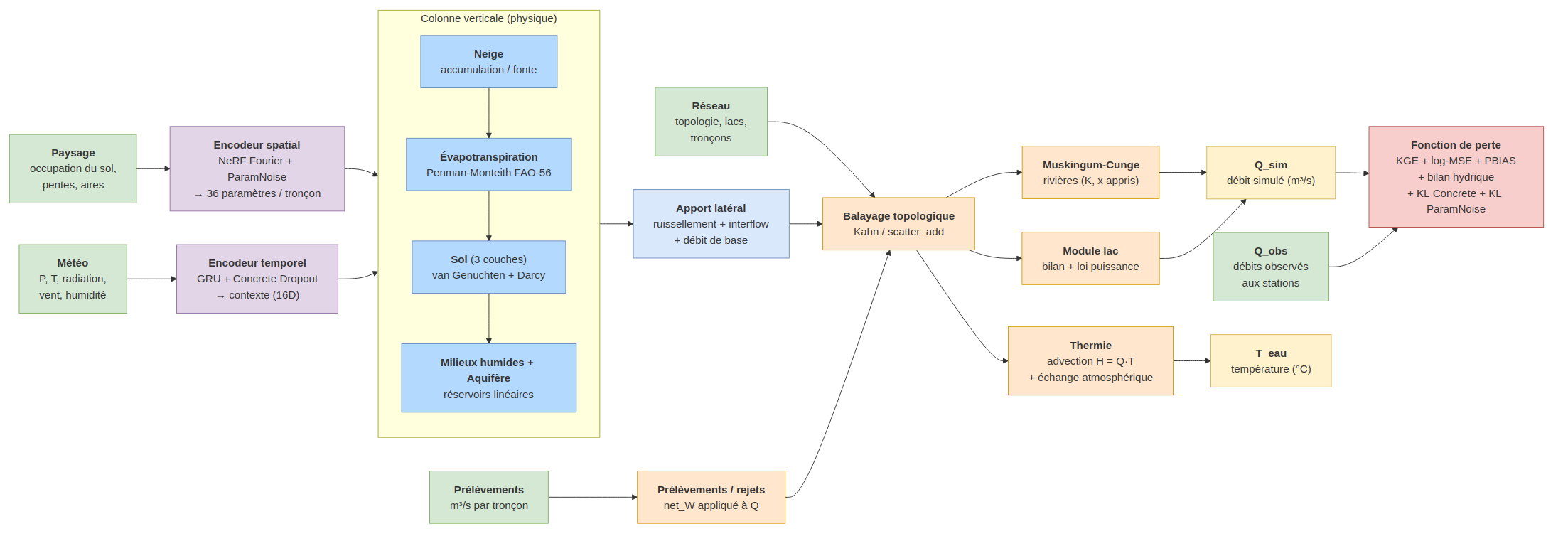
meandre implements hydrological processes within a differentiable programming framework. Because every operation in the simulation is differentiable, the gradient of any output (a hydrograph, a flux, a storage term) with respect to the model’s parameters and inputs is available through automatic differentiation. This enables
- gradient-based calibration, which scales to many parameters that vary naturally in space,
- an identifiable sensitivity analysis,
- hybrid models in which neural networks parameterize uncertain or poorly understood processes, while a conservation-law backbone keeps the model physically consistent, and
- uncertainty quantification, as an alternative to ensemble approaches.
The aim is models that remain interpretable and physically grounded while benefiting from modern optimization and deep learning.
Technical Implementation
- Hydrological process equations expressed in a differentiable framework (PyTorch)
- End-to-end automatic differentiation through the simulation
- Two modeling phases: first the central tendency, then the uncertainty
- Automated retrieval of the public data needed for modeling
- An autopilot that promotes convergence
Current Status
Active project under development. The differentiable core and gradient-based calibration are functional on test catchments. Validation across a broader range of hydrological conditions, along with the coupling of data-driven components, is ongoing.